

Choosing between insurance BPO companies used to be a back-office decision about claims keying and policy checking. Now it starts at the front desk, because the seat nobody can keep filled is the one answering the phone.
This guide reviews 10 providers, covering what each one runs, which insurance lines it serves, who it is built for, and where its scope ends. Every entry is based on what the provider publishes on its own pages.
Key Takeaways (TL;DR)
- The best overall insurance BPO companies: Sonant™ is the fit for independent P&C agencies and brokerages whose hardest gap is the phone, because it answers every call, opens the caller's record in the agency management system while the call is live, and writes the request back as a routed task. For claims adjudication, policy administration, and actuarial work at carrier scale, ReSource Pro™ and Xceedance™ are the insurance-only providers to shortlist.
- Why you need it: Insurance runs on work that has to happen whether or not you are staffed for it, and the two functions that break first are the phone and the back-office queue. Outsourcing turns a hiring problem into a capacity decision you can size and switch off.
- Who it's for: Carriers, MGAs, TPAs, and larger brokerages buy back-office insurance BPO services; independent agencies and mid-market brokerages usually buy the phone seat first, then decide about the rest.
- How to choose the right one: Match the provider to the function you need covered, check whether outcomes land inside your system of record or arrive as an email, and ask what licensing and compliance work the provider will and will not touch. Then price it against the minimum commitment, not the headline rate.
- Expected price: None of the 10 providers here publishes a rate card. Sonant quotes a flat partner rate per agency with onboarding, configuration, and support included, and the enterprise BPO firms quote per full-time employee, per transaction, or against an outcome, scoped to your volume and delivery location.
Top Insurance BPO Companies in 2026 at a Glance
Two things separate the providers below, which are the function they cover and the buyer they are built around. Read the category label first, because it decides more than the vendor name does.
How We Chose These Insurance BPO Providers
Insurance outsourcing is hard to compare, because two providers can both say "claims support" and mean a 400-person adjudication floor in one case and a document-indexing queue in the other. So the scoring below leans on what each company documents publicly rather than on what a salesperson would say in a scoping call.
We started from the providers that appear consistently in insurance BPO search results and analyst coverage, then shortlisted 10 against a weighted scoring system:
- Insurance specialization and lines covered (30%): Whether the provider names insurance segments on its own site, and which ones. We counted P&C, life and annuities, specialty, reinsurance, and intermediary work separately, because a firm strong in life administration is not automatically strong in retail P&C servicing.
- Systems integration and routing (25%): Whether work lands inside the agency management system, broker management system, or policy administration system as a structured record, and whether the provider reads that record as well as writing to it. A queue that produces an email is a different product from one that produces a task on the client's file.
- Phone and voice coverage (20%): Whether the provider answers inbound calls, and what it can complete on the call rather than pass along. We scored it the way an agency scores handling inbound calls internally, and it is where the roster splits hardest.
- Buyer fit and minimum commitment (15%): The size of organization each provider is designed around, taken from the segments it names and the clients it publishes.
- Published documentation (10%): Whether service scope, delivery footprint, and security posture are published rather than promised on a sales call. We applied that test evenly to all 10, Sonant included.
Every figure and capability statement in this comparison comes from a provider's own published pages. Confirm current scope and rates directly before you sign anything. Vendor-reported metrics are labeled as such throughout.
Where a company publishes a performance figure with no independent verification, we've said so rather than treating it as measured. A low score for published documentation means nothing was published for you to check rather than that the provider is weak, so ask before you conclude.
What Are Insurance BPO Companies?
Insurance BPO companies run insurance work on your behalf, using their own staff, their own delivery centers, and increasingly their own automation, while you keep the license, the carrier relationships, and the client.
The work is usually the repeatable middle of the policy lifecycle, meaning submissions, quoting support, policy issuance, endorsements, certificates, renewals, billing, claims intake and adjudication, licensing and compliance filings, and inbound customer contact.
The category is large and getting larger, as Mordor Intelligence puts the insurance BPO services market at "USD 68.40 Billion" in 2026, growing to "USD 93.12 Billion" by 2031 at a "6.36% CAGR", with North America holding "41.19% of the insurance BPO services market share in 2025" and claims processing alone accounting for "38.75%".
Underneath that single label sit four groups that behave differently once the work starts.
- Insurance-only BPO firms: Built for this industry and nothing else, staffed by people who already know an ACORD form from a bordereau. ReSource Pro and Xceedance sit here.
- Enterprise BPO and analytics firms: Global process companies with deep insurance practices alongside banking, healthcare, and utilities. EXL, WNS, Genpact, and Sutherland sit here.
- Consulting-led operations firms: They sell the core-system program and run the operations attached to it. Cognizant and Accenture sit here.
- Contact-center-led providers: Their center of gravity is customer contact volume rather than policy processing. Concentrix sits here.
There is now a fifth thing on the shortlist that isn't a BPO, which is insurance voice AI. It covers one function, the phone, without a seat behind it. Buyers increasingly shortlist AI receptionists for agencies alongside the process firms, which is why Sonant appears here, and the entry says plainly where the comparison stops.
Why Do You Need Insurance BPO Services?
Because insurance work arrives whether or not you are staffed for it, and the gap between the two is where retention breaks without a report showing it. A renewal still has to be re-marketed, a certificate still has to go out, and a caller with a claim still has to reach somebody, regardless of who resigned in March.
The cost of not covering it shows up in three places.
- Revenue that never becomes a submission: A quote call that goes to voicemail is a quote you didn't write. At the usual 12% commission, one small commercial account is worth roughly what eight or ten personal lines households are worth, and it renews every year the client stays.
An owner-operator with independent authority pays "between $9,000 and $17,000 per year for commercial truck insurance" according to AtoB, so a single missed trucking enquiry costs more commission than a week of answered service calls earns. Most owners never see the cost of missed calls, because the caller who gave up doesn't ring back to complain.
- Service quality that clients score you on: P&C is a retained-revenue business. Commissions renew annually, which makes hold times and callbacks a direct input to next year's revenue rather than a soft metric.
- Documentation that isn't there when you need it: Errors and omissions defense turns on what was written down at the time. Work that happens outside the system of record leaves nothing to defend with, which is why AMS call notes matter more than call recordings.
Where the two options split is what the work costs to run at your size. A back-office BPO engagement is priced and staffed for volume, which is why carriers buy it easily and a 20-person agency often can't.
Who Needs Insurance BPO Providers?
Insurance BPO providers fit organizations where the work volume is steady, the process is repeatable, and the bottleneck is people rather than strategy. These five buy it most often, and they buy different things.
Property and Casualty Carriers
Carriers outsource where volume is highest and variance is lowest, which is claims intake and adjudication, policy issuance, endorsements, and premium audit. The buying trigger is usually a catastrophe season that exposes how little surge capacity the in-house team has, or a core-system migration that needs bodies on the old process while the new one is built.
These buyers need documented quality control, defined service levels, and a provider that can staff a surge without a six-month recruiting cycle. Claims volume usually arrives through the phone first, which makes FNOL intake the pressure point during a catastrophe week.
Life, Annuity, and Group Benefits Insurers
Life and annuity books carry decades of administration on systems nobody wants to touch, so third-party administration is a common answer. The work is policy servicing, beneficiary changes, claims payout, and reporting, all of it under strict state regulation.
These buyers need a provider licensed to administer in the states they write in, and they weigh regulatory track record above unit cost.
MGAs, Wholesalers, and Program Administrators
MGAs sit between capacity and distribution with small teams and heavy operational load, including submission clearance, bordereaux, binding, and carrier reporting. Growth is capped by how fast the back office can process, not by how much business the front office can find.
These buyers need a provider that already understands delegated authority and can produce carrier-ready reporting without being taught what a bordereau is.
Mid-Market and Large Brokerages
Brokerages with 25 or more people outsource to protect the client-facing roles. The work that leaves is policy checking, certificate issuance, data entry, renewal preparation, and licensing compliance across states or provinces.
The work that stays is the relationship. These buyers care most about whether outcomes land in Applied Epic, AMS360, or their broker management system as records their own team can find, and whether calls still reach the account manager who owns the client.
Independent Insurance Agencies
Independent agencies of 10 or more people rarely need a back-office floor, and most cannot meet the minimum commitment to buy one. Their gap is narrower and more expensive, which is the phone.
When the person who answers it leaves, the calls fall to producers and CSRs who are already quoting, and the agency starts losing quote opportunities without any report showing it. This band usually starts with the phone seat and decides about the rest later, weighing it against an offshore virtual assistant or another hire.
Best Insurance BPO Companies: In-Depth Review and Comparison
Each entry covers what the provider runs, who it is built around, what it publishes, and where its scope ends for the buyer this guide is written for.
1. Sonant™
Overview
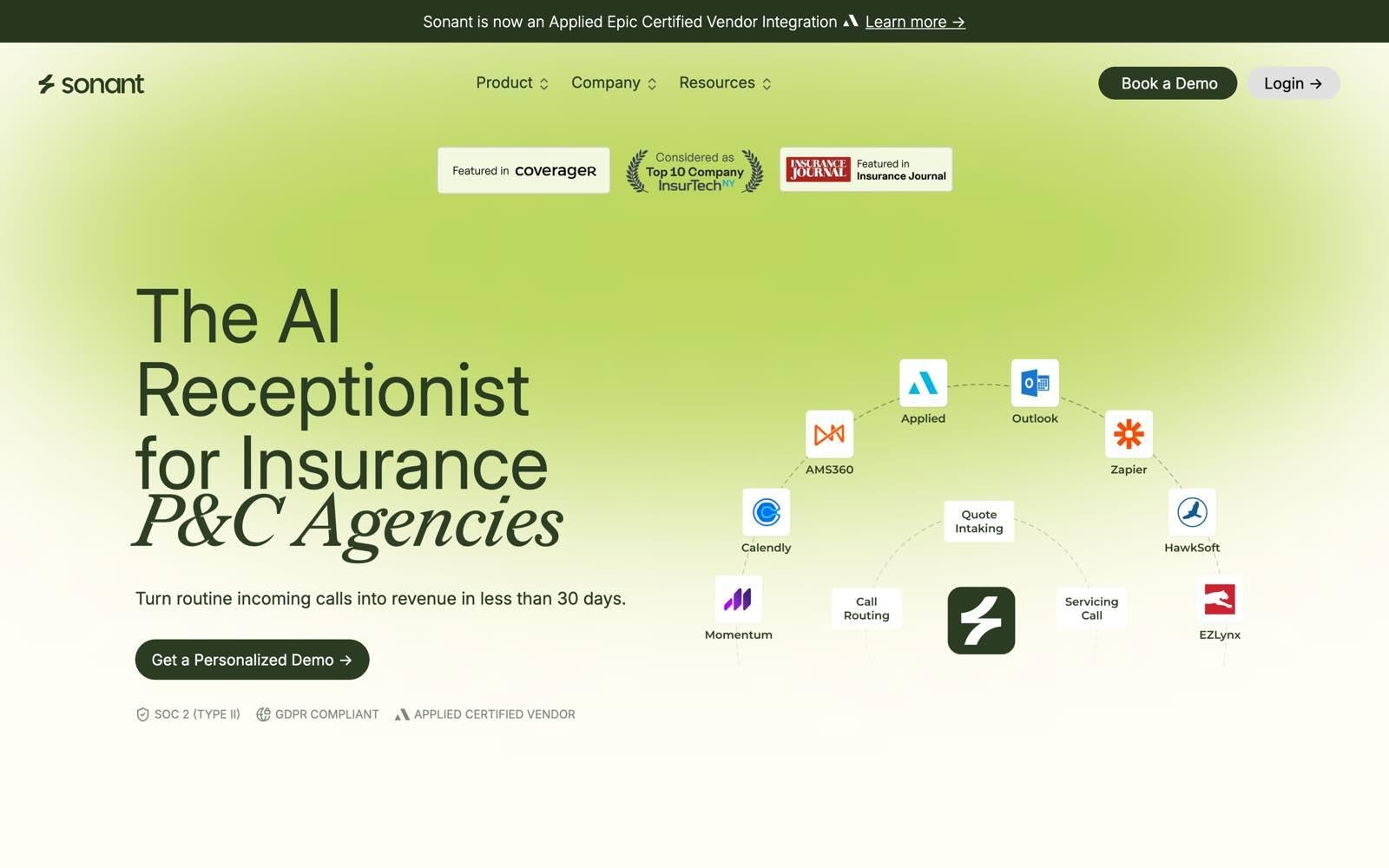
Sonant is the AI receptionist built for independent property and casualty (P&C) insurance agencies and Canadian brokerages. It answers every inbound call around the clock, recognizes and verifies the caller, opens their record in the agency management system (AMS) while the call is still live, takes the information a quote or service request needs, and turns the call into a task routed to whoever owns that account.
It belongs on a list of insurance BPO companies for one reason, which is that the phone is the function agencies outsource first and the one a back-office engagement usually doesn't cover.
Sonant works alongside the rest of your operation and alongside your team rather than standing in for either. Agencies keep their CSRs and producers and hand over the routine traffic those people were absorbing between quotes.
Ideal For
- Independent P&C where the general line rings out to everyone
- Agencies whose receptionist is retiring, moving into a licensed role, or already gone
- Operations leaders routing callers to assigned CSRs and account managers
- Agency networks standardizing phone handling across branches
- Canadian brokerages running Applied Epic, Acturis, or PowerBroker
Top Features
- Live record lookup during the call: Sonant pulls policy, coverage, renewal date, and deductible from the AMS while the caller is on the line, so a servicing request gets finished rather than logged for a callback.
- Triage into routed tasks: Every call ends as a structured record in the system your team already opens, assigned to the right person, which is what separates it from message taking.
- Warm transfer with context and VIP routing: Calls hand off to a person with the detail attached, and chosen clients can bypass the AI entirely.
- Multilingual answering: English, Spanish, and Portuguese among others, with mid-call language switching.
- Mid-call texting: Sonant can send a payment link or a carrier claims link during the conversation instead of promising to email it later.
Why We Stand Out?
Sonant arrives knowing P&C terminology and workflow, so there is no script to build and no blank canvas to fill in. Its native AMS integrations are two-way API connections to Applied Epic, AMS360, EZLynx, HawkSoft, Momentum AMP, and QQCatalyst, alongside Google, Outlook, Calendly, and Cal.com calendars and Zapier.
Sonant is an Applied Certified Integration Vendor, the first voice AI platform certified for Applied Epic.The published customer results speak to the staffing gap directly. Century Insure, a Pennsylvania agency of around 14 people, went live 17 days after the kickoff call while three staff seats were down including the receptionist, and answered every call from day one.
Firefly Network reported a 90% reduction in manual routing across 200 or more independent branches after its longtime receptionist retired, with 2,000 or more calls handled and zero customer complaints.
At Cornerstone Insurance, a Saskatchewan brokerage, staff productivity rose 43% and COO Brock Longworth described the underlying problem in the terms most owners recognize: "The revenue from it doesn't justify us bringing on two, three, four receptionists."
Pros
- Covers the phone seat without adding headcount, a night shift, or a minimum agent commitment
- Call outcomes land in the AMS as routed tasks automatically, so documentation doesn't depend on someone typing notes
- Routes callers to their assigned CSR by looking up who owns the account in the system of record
- Multilingual handling with mid-call switching, rather than a separate bilingual line at extra cost
- Flat rate per agency that doesn't move when a storm week triples call volume
Cons
- Covers the phone and nothing else, so an insurer needing claims adjudication or policy administration at scale needs a back-office provider alongside it
- Built for insurance, so an organization outside P&C and life distribution should shortlist elsewhere
- No public rate card, which means a scoping conversation before you can compare cost line by line
Pricing
Sonant quotes a flat partner rate per agency or brokerage rather than a per-minute or per-seat tier, and onboarding, configuration, and support are included. Because the bill isn't tied to call volume, a hard-market renewal season doesn't produce a surprise invoice. The trade-off is that you need a demo to get a number.
Final Verdict
Sonant is the fit for an independent agency or brokerage where the phone is the seat nobody can keep filled, because it treats a live call the way a good CSR would, by verifying who is calling, opening their record, finishing what can be finished, and putting the rest in front of the right person as a task.
The AMS write-back breakdown covers how that record gets created. The limitation is scope, since Sonant covers one function and a carrier that needs 200 people on claims adjudication is buying a different product entirely.
2. ReSource Pro™
Overview
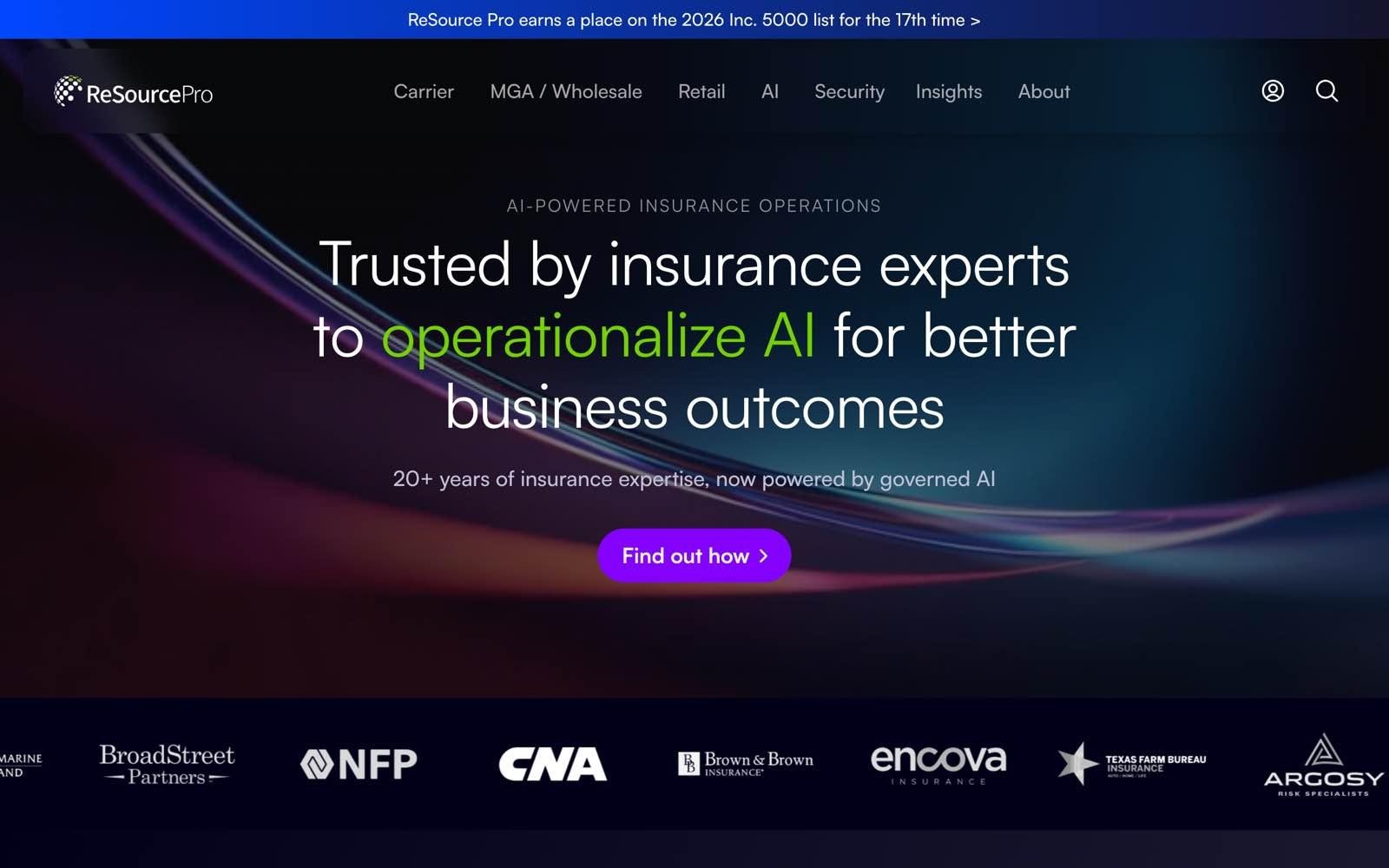
ReSource Pro has run insurance operations since 2003 and works only in this industry. Its own site organizes the business around three buyer types, which are retail agencies and brokerages, carriers, and MGAs and wholesalers, and that separation shows up in the service lines rather than being marketing framing.
For retail brokers it covers new business, policy servicing, revenue management, account management, and employee benefits. For carriers and MGAs it covers new business, accounting, renewals, and claims.
Compliance runs across all three, including licensing, surplus lines, compliance reviews, and corporate compliance. Its about page states "12,000+ team members" and "2,000+ insurance clients", and the homepage notes it "earns a place on the 2026 Inc. 5000 list for the 17th time" (company-reported, September 2026).
Ideal For
- Retail brokerages outsourcing policy checking, certificates, and renewal preparation
- Agencies carrying multi-state licensing and surplus lines filing obligations
- MGAs and wholesalers needing carrier-ready processing without in-house headcount
- Carriers looking for insurance-trained operations staff rather than a general BPO floor
- Organizations that want operations and agency technology managed by one provider
Top Features
- Segment-specific service lines: Retail, carrier, and MGA work is scoped separately, so a broker isn't buying a carrier process with the labels changed.
- Regulatory compliance as a standing service: Licensing, surplus lines, compliance reviews, and entity governance run as ongoing work rather than project engagements.
- Managed technology services: Agency system administration and data services sit alongside the process work, which suits teams with no internal insurance IT.
Why They Stand Out?
ReSource Pro is one of the few providers on this list whose entire business is insurance distribution operations, and it publishes that focus down to the service-line level for each buyer type.
For a retail brokerage that wants policy checking, certificate issuance, and licensing compliance handled by people who already know the forms, it is a strong fit for that buyer.
Pros
- Insurance-only focus across retail, carrier, and MGA operations
- Compliance, licensing, and surplus lines run as continuous services
- Long operating history in this industry, published as continuous since 2003
- Technology services offered alongside process work, under one provider
- Buyer-specific service catalogs published on its own site
Cons
- Built for organizations with steady back-office volume, so a smaller agency should confirm minimum engagement size early
- No published pricing, so the cost can't be modeled until a scoping conversation is finished
- Inbound phone answering is not among the service lines it names for retail brokers; verify voice scope with the provider directly
- Delivery footprint and staffing model are not published in detail on the site
Pricing
ReSource Pro publishes no rate card. Engagements are scoped to the functions covered and the volume involved, which means a written proposal is the starting point for any comparison.
Final Verdict
Shortlist ReSource Pro when a retail brokerage, MGA, or carrier needs insurance-trained people running policy servicing, renewals, and compliance filings continuously.
It becomes a weaker fit for an agency whose only real gap is inbound call coverage, since the published service lines are built around processing work rather than answering the phone, and the engagement size that makes back-office outsourcing economic is beyond what most sub-25-person agencies can commit to.
3. Xceedance™
Overview
Xceedance works exclusively in insurance and covers a wider span of the value chain than most, running operations, claims third-party administration, technology, and data and analytics for the same client.
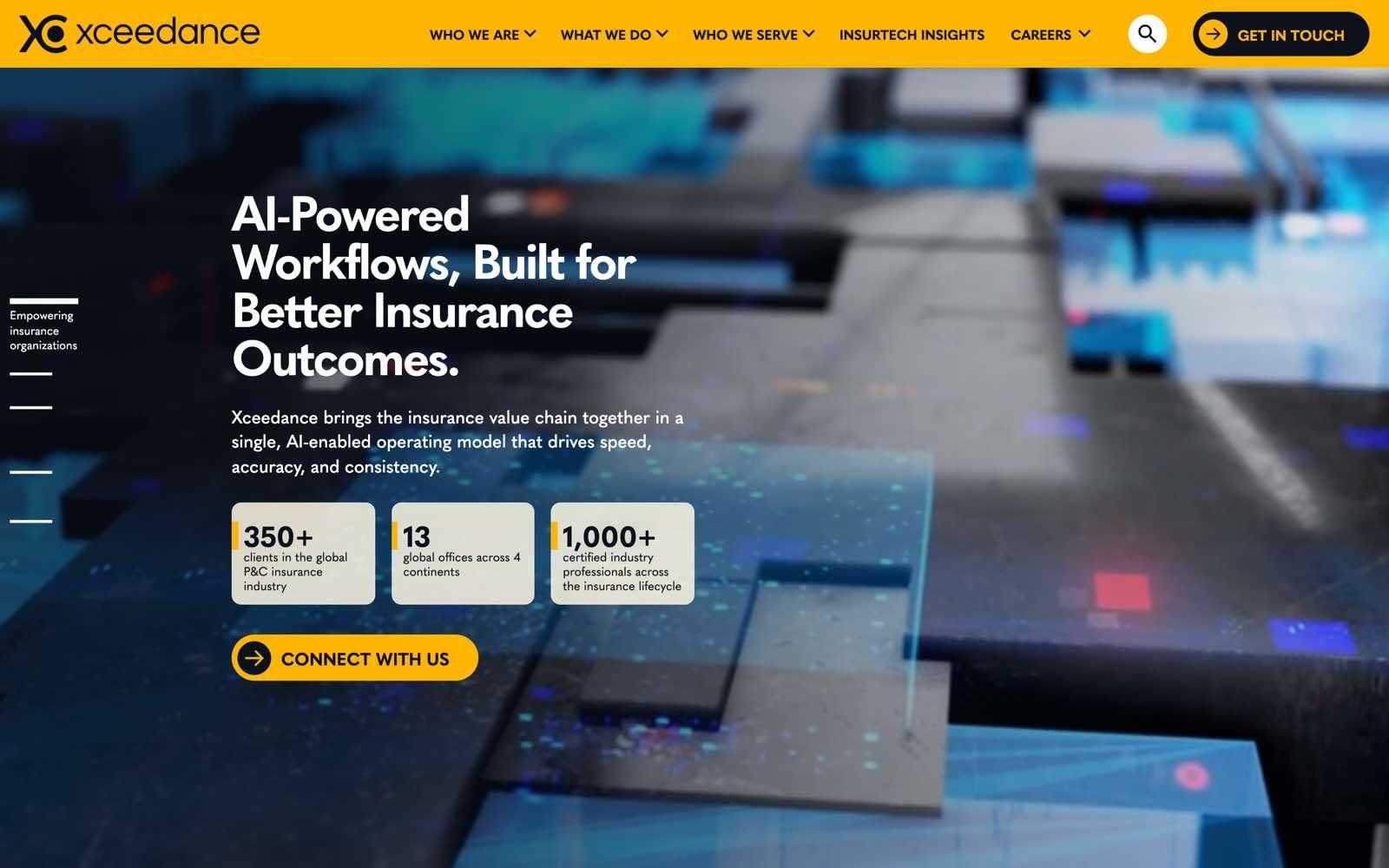
Its own homepage states "350+ clients in the global P&C insurance industry", "13 global offices across 4 continents", and "1,000+ certified industry professionals across the insurance lifecycle" (company-reported, September 2026).
The named service areas include underwriting support, property inspection, policy service, billing and collections, finance and accounting, print and distribution, and a digital contact center.
It serves insurers, reinsurers, MGAs and underwriting agencies, and agents and brokers, and it publishes analyst recognition including a "Star Performer" placement in Everest Group's 2025 P&C insurance business process assessment.
Ideal For
- P&C insurers needing underwriting, policy service, and claims administration from one provider
- MGAs and underwriting agencies wanting operations and technology under a single contract
- Reinsurers needing actuarial, catastrophe, and exposure management support
- Carriers standing up a new entity or program that needs operations built from scratch
- Organizations that want contact-center coverage bundled with back-office processing
Top Features
- Full lifecycle coverage: Underwriting through billing, claims, and finance, which reduces the number of vendors touching one policy.
- Actuarial and catastrophe modeling: Available alongside process work, which matters for specialty and property carriers.
- Digital contact center: Published as a named service line, so voice coverage is in scope rather than assumed.
Why They Stand Out?
For a P&C insurer or MGA that wants operations, technology, and analytics from a single insurance-only provider rather than assembling three vendors, Xceedance is a strong fit for that combination. Its published client base is concentrated in P&C rather than spread across industries, which shows in how specific the service catalog is.
Pros
- Insurance-only, with a published P&C client base of 350 or more
- Underwriting, claims TPA, actuarial, and contact center available together
- Named delivery footprint of 13 offices across four continents
- Independent analyst recognition published with the assessment and year
- Agents and brokers named as a served segment, not only carriers
Cons
- Designed around insurers, MGAs, and reinsurers, so retail agency workflows aren't the design center
- No published pricing, so any comparison requires a sales conversation
- The published proof points are carrier and program results rather than independent agency results
- Breadth means a smaller buyer may be paying for a catalog far wider than the one function it needs
Pricing
Xceedance publishes no pricing. Engagements are quoted by scope and volume, and the range between a single contact-center function and a full lifecycle operating arrangement is wide enough that only a written proposal is meaningful.
Final Verdict
Xceedance is recommended for P&C insurers, MGAs, and reinsurers that want operations, claims administration, and analytics from one insurance-specialist provider.
It is a weaker fit for an independent retail agency, because the published capabilities, client base, and delivery model are built around carrier-side and program-side volume, and an agency buying only phone coverage would be contracting with a firm whose design center sits elsewhere.
4. EXL™
Overview
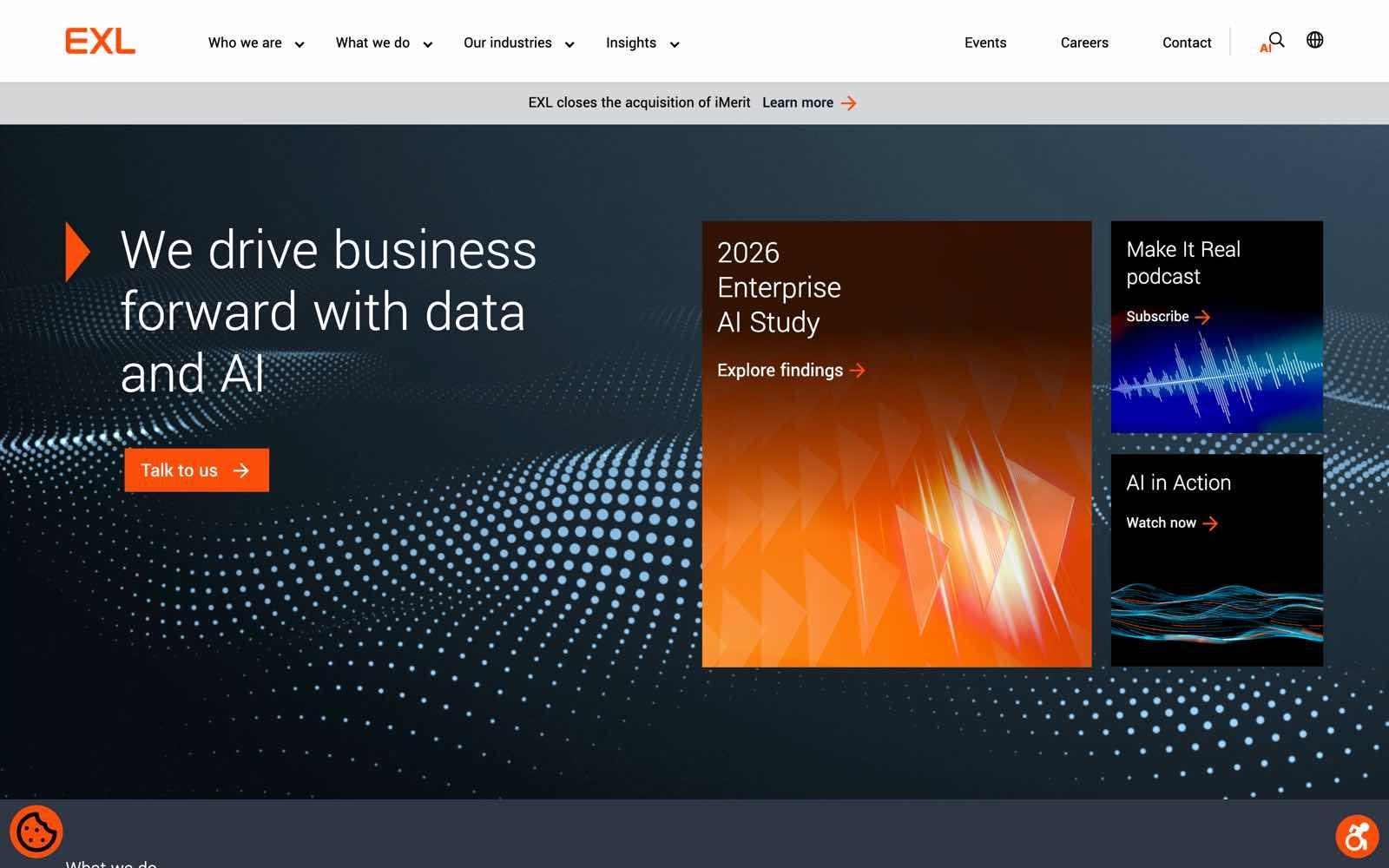
EXL runs insurance operations alongside a large data and analytics business, and it positions the two together. Its insurance page states that EXL serves "over 430 global insurance clients" and is "Licensed as a TPA" operating "in all 50 states & DC" (company-reported, September 2026), which is a meaningful detail for anyone outsourcing claims payout rather than claims support.
The published service areas are sales and distribution, intelligent underwriting, policy administration, claims management, customer experience, third-party administration, premium audit, and finance transformation. Named segments are individual and group life, general insurance, and the Lloyd's of London market, with brokers and insur-techs named as buyers.
Ideal For
- Carriers needing a licensed third-party administrator across all US states
- Life and annuity insurers administering closed or legacy blocks
- General insurers wanting underwriting and claims operations with analytics attached
- Lloyd's market participants needing syndicate-side operational support
- Brokers and insur-techs outsourcing operations while keeping distribution in-house
Top Features
- TPA licensing across all 50 states and DC: Published on its own page, which shortens diligence for buyers who need administration rather than support.
- Premium audit as a named service: A specific, commonly outsourced commercial lines function rather than a generic label.
- Analytics attached to operations: Claims and underwriting work sits next to the data services rather than in a separate contract.
Why They Stand Out?
EXL suits carriers that wants claims and policy administration run by a licensed administrator with analytics capability in the same contract. The published TPA licensing position and the 430-plus insurance client count give a buyer something concrete to verify early in diligence.
Pros
- Licensed as a TPA in all 50 states and DC, published on its own page
- Published insurance client base of over 430 organizations
- Life, general insurance, and Lloyd's market all named as served segments
- Premium audit and third-party administration named as distinct services
- Analytics and data services available under the same provider
Cons
- Built for global insurers, reinsurers, and large brokers, so retail agency servicing is not the design center
- No published pricing, so the cost can't be modeled before a scoping engagement
- The insurance business sits inside a much larger multi-industry firm, so ask which delivery teams are insurance-dedicated
- No published results for independent agency or small brokerage buyers
Pricing
EXL publishes no rate card. Work is quoted by function, volume, and delivery location, and the analytics components are typically scoped separately from the process work.
Final Verdict
The case for EXL is strongest at carriers, Lloyd's market participants, and large brokers that need licensed third-party administration and analytics from one provider.
It is a weaker fit for agencies and smaller brokerages, since the published segments, client base, and TPA positioning all point at carrier-side volume, and a buyer whose only gap is inbound calls would be signing an enterprise operating arrangement to cover a front-desk function.
5. WNS™

Overview
WNS runs one of the larger insurance practices in the enterprise BPO field and publishes its scale alongside the service list. As of September 2026 it presents itself as part of Capgemini, with the Capgemini lockup in its own masthead and the acquisition announced on its about page, so factor the ownership change into a multi-year contract.
Its insurance page states "18,000+ insurance specialists", "650+ actuarial & analytics specialists", ">70 Global Clients", "400+ analytics programs delivered", and "30 million+ claims transactions processed" (company-reported, September 2026).
Named segments are life and annuities, property and casualty, insurance intermediaries and brokers, and the Lloyd's of London market.
The service list covers claims management, policy administration, underwriting support, customer contact, actuarial modeling, finance and accounting, and broker support, with named internal systems including a digital policy administrator, an underwriting workbench, and a workflow manager.
Ideal For
- Life and annuity insurers administering large in-force books
- P&C carriers moving claims volume to a provider with published transaction scale
- Insurance intermediaries and brokers outsourcing operations support
- Lloyd's market participants needing syndicate operations
- Insurers wanting actuarial modeling and process work from the same provider
Top Features
- Published transaction scale: 30 million or more claims transactions processed, which gives a buyer a size reference most providers don't publish.
- Dedicated actuarial bench: 650 or more actuarial and analytics specialists named separately from the operations headcount.
- Broker support as a named segment: Intermediary work is scoped in its own right rather than treated as a subset of carrier work.
Why They Stand Out?
Few providers publish as much of their own scale as WNS does, which makes it a strong fit when the decision has to be underwritten with numbers. It names headcount, client count, and transaction volume on its own insurance page. Naming intermediaries and brokers as a segment also makes it more relevant to distribution-side buyers than most enterprise BPO firms.
Pros
- Published insurance headcount of 18,000 or more specialists
- Dedicated actuarial and analytics bench published separately
- Life, P&C, intermediary, and Lloyd's segments all named
- Named internal systems for policy administration and underwriting
- Broker support scoped as its own service line
Cons
- The published count of more than 70 clients against 18,000-plus specialists indicates an engagement size built for large organizations
- No published pricing, so any comparison requires a sales conversation
- Metrics are vendor-reported with no independent verification published alongside them
- Insurance sits within a broad multi-industry firm, so confirm which teams are insurance-dedicated
- Ownership changed with the Capgemini acquisition announced on its own site, so confirm delivery continuity for the accounts you care about
Pricing
WNS publishes no rate card. Engagements are quoted by process, volume, and delivery geography, and the system-based arrangements it names are typically scoped differently from staff-based ones.
Final Verdict
Buy WNS when documented scale is what has to underwrite the decision, which describes a life, annuity, or P&C insurer, or a large intermediary, moving claims and policy administration.
It is a weaker fit for most independent agencies and mid-market brokerages, because a published ratio of more than 70 clients to 18,000-plus specialists points to engagements far larger than a distribution-side buyer needs, and the phone coverage a smaller agency is usually shopping for is a small corner of what this contract would cover.
6. Cognizant™

Overview
Cognizant sells insurance business process services alongside its core-system implementation work, and its own page scopes the two together rather than as separate offerings. Its insurance BPO page names life and annuities, property and casualty, and workers compensation as covered segments, and describes claims work as spanning "first notice of loss (FNOL) to assessment, claims adjudication, subrogation, reserve management and payments".
It publishes analyst placement in Everest Group's 2025 assessments for P&C insurance business process services, life and annuities business process services and third-party administration, and customer experience services in insurance operations.
It also publishes outcome figures including "20% lower costs per policy" and "20% shorter call length and costs" (company-reported, September 2026, with no independent verification published alongside them).
Ideal For
- Carriers running a core-system migration who need operations covered during the change
- Life and annuity insurers needing third-party administration and technology together
- Workers compensation carriers outsourcing claims analysis
- P&C insurers modernizing claims from FNOL through payment
- Organizations wanting one provider accountable for both the core system and the process
Top Features
- Claims coverage end to end: FNOL through adjudication, subrogation, reserve management, and payments, described as one chain rather than separate services.
- Core systems and process under one provider: Useful when the operating model changes at the same time as the technology.
- Workers compensation as a named segment: A specialist line most enterprise providers fold into general P&C.
Why They Stand Out?
Cognizant suits carriers where the process change and the system change are the same program, since it can staff the operations while its technology teams run the migration. The published analyst placements across three separate insurance categories give a buyer independent reference points that most providers on this list don't offer.
Pros
- Insurance BPO sold alongside core-system implementation and support
- Everest Group leader placements published across three insurance categories for 2025
- Claims coverage published from FNOL through payments
- Workers compensation named as a distinct segment
- Customer care available alongside back-office processing
Cons
- Built for carriers modernizing core systems, so distribution-side and agency workflows aren't the design center
- No published pricing, so the cost can't be modeled until a scoping conversation is finished
- The published outcome figures are vendor-reported and carry no stated methodology
- Engagements are typically program-sized, which sets a high floor for entry
Pricing
Cognizant publishes no pricing for insurance business process services. Work is quoted per program, and the process component is often scoped inside a larger technology engagement rather than separately.
Final Verdict
Cognizant is recommended for carriers running claims, policy administration, or life and annuity administration alongside a core-system program, where having one provider accountable for both is worth the contract size.
It’ll be a weaker fit for agencies and smaller brokerages, since the published segments are all carrier-side and the engagement model assumes a program budget rather than a single function that needs covering next month.
7. Genpact™

Overview
As of September 2026, Genpact runs insurance operations with analytics and process design attached, and names brokers and MGAs alongside carriers as buyers, which is less common among the enterprise firms. Its insurance page covers sales transformation, underwriting, policy administration, claims, and reinsurance operations, and names an insurance policy suite among its own products.
It publishes independent analyst recognition, including leader placement in ISG's "Strategic Capabilities, Insurance GenAI and Agentic AI Services, 2025" and HFS Horizons market leader placement for "Generative Enterprise Services, 2025". It also publishes a specialization in Guidewire, which matters if that is your policy administration system.
Ideal For
- Carriers and reinsurers outsourcing underwriting and claims operations
- Brokers and MGAs wanting process work from an enterprise provider
- Insurers running Guidewire who want operations staff already trained on it
- Life and annuity insurers administering in-force blocks
- Organizations pairing process redesign with the operations that follow it
Top Features
- Guidewire specialization: Published as a named capability, which shortens ramp for carriers on that system.
- Reinsurance operations as a named line: A specific and commonly under-served function.
- Brokers and MGAs named as segments: Distribution-side buyers are scoped rather than assumed into carrier services.
Why They Stand Out?
For a carrier or reinsurer that wants process redesign and the operations that follow it from the same provider, particularly on Guidewire, Genpact is a strong fit. Naming brokers and MGAs as first-class segments also makes it more approachable for distribution-side buyers than most firms of its size.
Pros
- Brokers, MGAs, life and annuity, P&C, and reinsurance all named as segments
- Guidewire specialization published as a named capability
- Independent analyst recognition published with firm, category, and year
- Reinsurance operations scoped as its own service line
- Process design and operations available under one provider
Cons
- Publishes no client counts or headcount on its insurance page, so scale has to be verified in diligence
- No published pricing, so any comparison requires a sales conversation
- Insurance sits inside a broad multi-industry firm, so ask which delivery teams are insurance-dedicated
- No published results for independent agency buyers
Pricing
Genpact publishes no rate cards. Engagements are quoted by process scope and volume, and the analytics and design components are usually scoped separately from ongoing operations.
Final Verdict
Genpact earns its place with carriers, reinsurers, and larger MGAs that want underwriting or claims operations designed and then run by one provider, especially on Guidewire.
It is a weaker fit for independent agencies, because no agency-side proof points or client counts are published for a buyer to check, and the process-redesign model it leads with assumes an organization with enough process volume to justify redesigning it.
8. Sutherland™
Overview
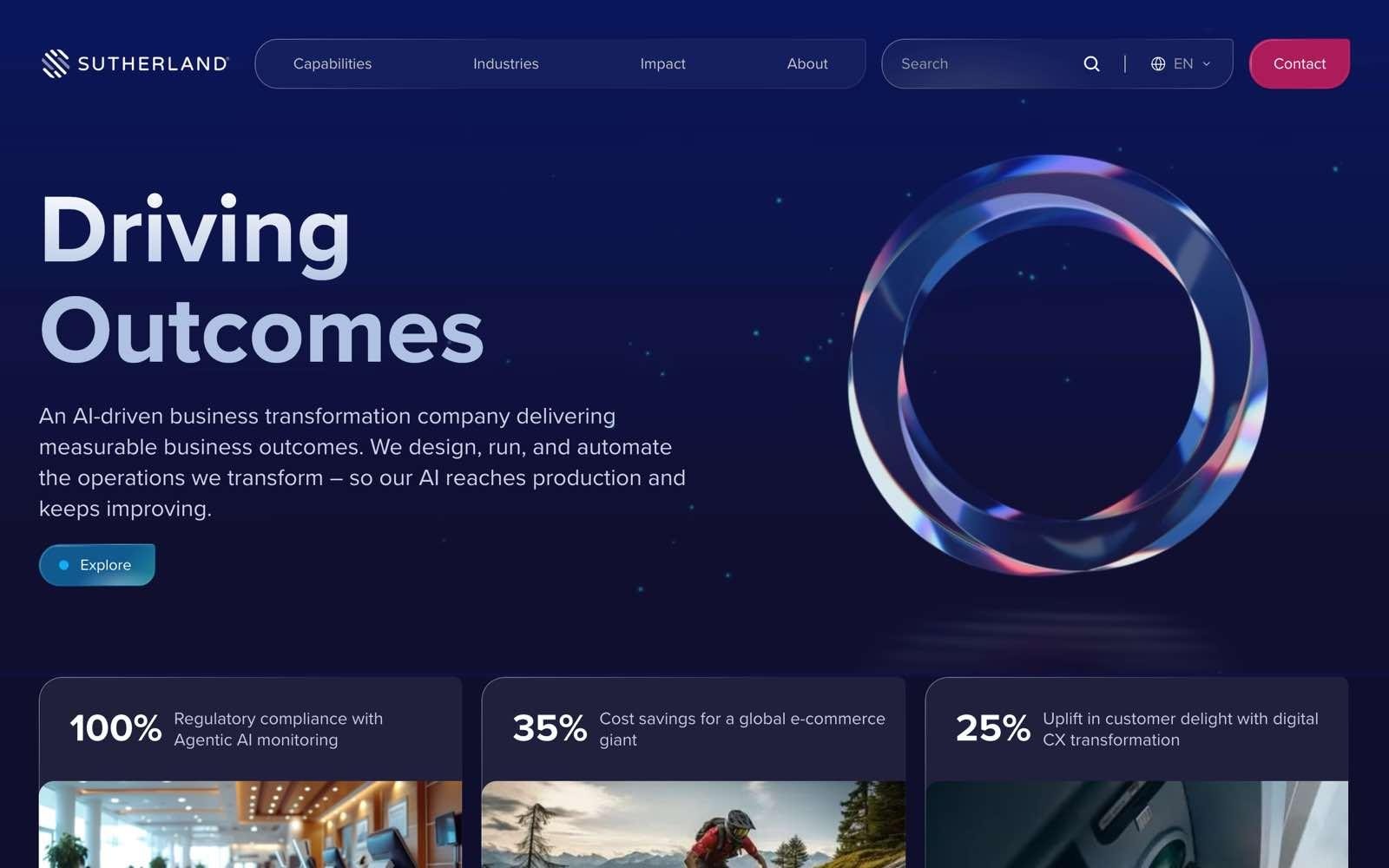
Sutherland positions itself as "an AI-driven business transformation partner" combining insurance domain teams, its own AI agents, and engineering. Its insurance page names property and casualty, commercial and specialty, life, annuity and group benefits, and insurance intermediaries including MGAs, brokers, and distribution.
The service list covers FNOL, underwriting and claims automation, policy administration and modernization, sales and customer service, cloud migration, data analytics and compliance operations, and billing, collections, and reinsurance support.
It publishes outcome figures including "$600M+ in annual premium sales written", "$2B+ in premiums serviced annually", "70%+ FNOL automation", and "NPS of 80+" (company-reported, September 2026, with no independent verification published alongside them).
Ideal For
- P&C and specialty carriers automating first notice of loss intake
- Insurers combining policy administration with legacy system migration
- Intermediaries, MGAs, and distributors outsourcing sales and service operations
- Life, annuity, and group benefits insurers needing administration support
- Organizations wanting premium sales and servicing handled by the same provider
Top Features
- Premium sales operations: It publishes premium written and premium serviced figures, which is unusual and useful for distribution-side buyers.
- FNOL automation: Named as a specific measured function rather than folded into general claims work.
- Intermediaries named as a segment: MGAs, brokers, and distribution scoped in their own right.
Why They Stand Out?
Sutherland suits insurers and intermediaries that wants revenue-side operations, meaning sales and servicing, run alongside claims and policy work. Publishing premium written and premium serviced gives a buyer a size reference tied to insurance outcomes rather than headcount.
Pros
- Publishes premium written and premium serviced figures tied to insurance outcomes
- P&C, commercial and specialty, life, and intermediaries all named as segments
- FNOL automation published as a distinct capability
- Sales operations offered alongside servicing and claims
- Reinsurance support named as its own service line
Cons
- Publishes a large set of proprietary automation products, so confirm which parts of the delivery depend on adopting them
- No published pricing, so the cost can't be modeled until a scoping conversation is finished
- The performance figures are vendor-reported with no stated methodology
- Built for insurers and larger intermediaries, so retail agency phone handling isn't the design center
Pricing
Sutherland publishes no rate card. Engagements are quoted by function and volume, and the technology components are typically priced alongside rather than inside the operations scope.
Final Verdict
Shortlist Sutherland when sales, servicing, and claims operations need to sit with one provider and automation is part of the point, which fits P&C, specialty, and life insurers and larger intermediaries.
It is a weaker fit for independent agencies, since the published proof is carrier-scale premium volume rather than agency results, and an agency needing the phones answered next month would be buying an operating arrangement larger than the function it needs covered.
9. Concentrix™
Overview
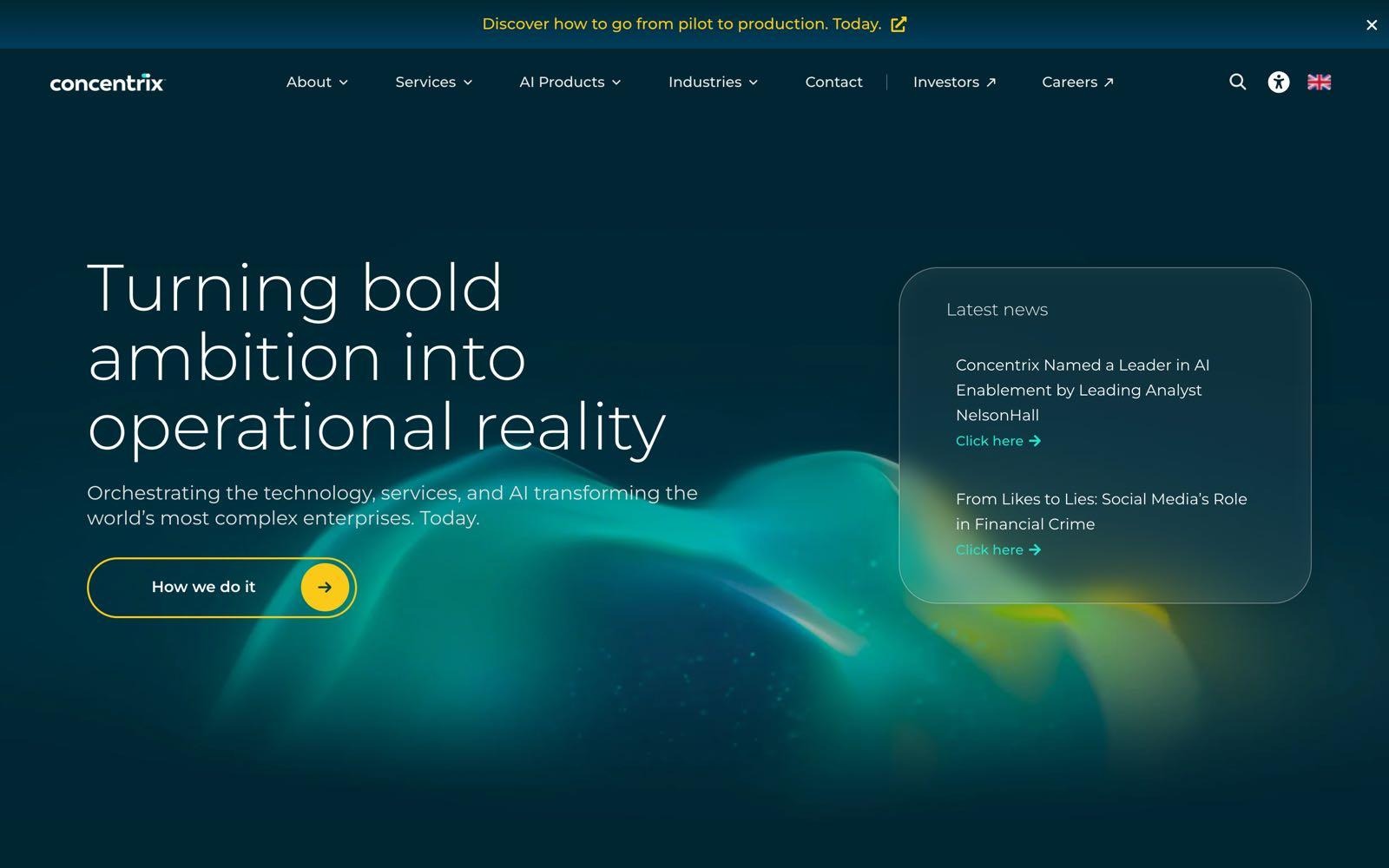
As of September 2026, Concentrix comes at insurance from customer contact rather than policy processing, and its insurance page reflects that. The four published areas are acquisition and retention, policy support, claims management, and fraud and compliance, with its own AI product suite named across them.
That orientation makes it a different kind of buy from the process firms above. The work is centered on the conversation with the policyholder, including sales, service, claims contact, and the compliance checks around them, rather than the underwriting and administration behind it.
Ideal For
- Insurers running high inbound and outbound contact volume
- Carriers needing sales and retention calling alongside service
- Organizations outsourcing claims contact rather than claims adjudication
- Insurers needing know-your-customer and alert processing at volume
- Direct-to-consumer insurance brands where contact volume is the operation
Top Features
- Contact-led coverage: Acquisition, retention, service, and claims contact scoped as one operation.
- Fraud and compliance monitoring: Know-your-customer navigation and alert processing published as a named service.
- Named AI product suite: Its own tooling is published rather than described generically.
Why They Stand Out?
Where the operation is fundamentally a contact operation and conversation volume is the thing being staffed, Concentrix is one of the strongest options. Scoping acquisition and retention alongside service means one provider covers both sides of the policyholder relationship.
Pros
- Built around customer contact, which is where most policyholder friction sits
- Acquisition, retention, service, and claims contact covered together
- Fraud and compliance monitoring named as a distinct service
- Proprietary AI tooling published rather than described in general terms
- Direct-to-consumer insurance contact is a natural design center
Cons
- Insurance sits alongside many other industries, so P&C depth needs verifying in diligence
- No client counts, performance metrics, or case-study figures published on its insurance page
- No published pricing, so any comparison requires a sales conversation
- Agency management system integration is not published; verify the integration path with the provider directly
Pricing
Concentrix publishes no pricing. Contact-center work is generally quoted per agent or per contact against forecast volume, and the tooling is typically scoped alongside the staffing rather than inside it.
Final Verdict
Concentrix suits insurers and direct-to-consumer brands whose operation is built around contact volume, where sales, service, and claims conversation all need staffing together.
It is a weaker fit for independent agencies, because nothing published on the insurance page addresses agency management system integration or P&C distribution workflow, and an agency would be buying contact-center capacity without the system connection that makes a call useful afterwards.
10. Accenture™
Overview
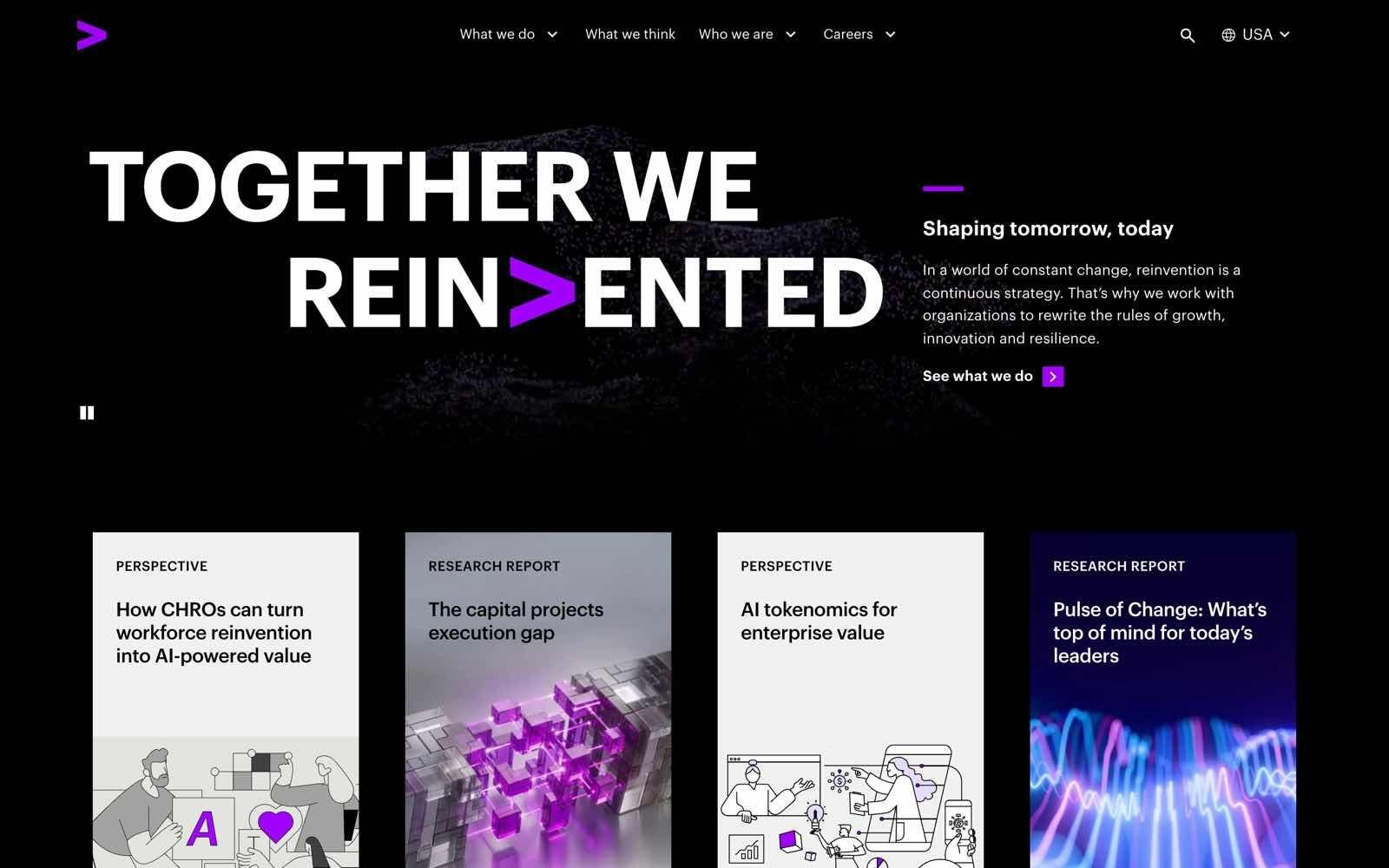
Accenture is the consulting-led end of this list. Its insurance work is organized around technology and operations, AI-assisted claims, and AI-assisted underwriting, with property and casualty across personal and commercial lines, life and annuity, and group and voluntary benefits named as segments.
The operations work usually arrives attached to a technology program, and its named partnerships with Guidewire and Duck Creek point at where that program normally sits. It publishes research figures including that "40% of a typical insurance underwriter's time is consumed by non-core activities" (company-reported research, September 2026).
Ideal For
- Large carriers replacing or upgrading a core policy administration system
- Insurers redesigning the underwriting operating model
- Life and annuity insurers needing policy system administration and operations together
- Group and voluntary benefits carriers modernizing service delivery
- Organizations that need the strategy, the build, and the run from one firm
Top Features
- Core-system partnerships: Guidewire and Duck Creek named, with Accenture describing itself as the only Premier Platinum partner for Duck Creek, which matters if your system is one of them.
- Life and annuity administration: A named administration capability rather than a general operations claim.
- Underwriting redesign: Published as its own work stream with research attached.
Why They Stand Out?
Accenture suits large carriers where the operating model and the core system are changing together and the buyer wants one firm accountable across strategy, build, and run. The published core-system partnerships give a carrier a concrete starting point for the conversation.
Pros
- Strategy, implementation, and operations available from one firm
- Named partnerships across the Guidewire and Duck Creek core systems
- P&C personal and commercial, life and annuity, and group benefits all named
- Life and annuity administration published as a specific capability
- Published research on underwriting time and consumer behavior
Cons
- Consulting-led, so the operations work usually arrives inside a larger program
- Insurance is one industry among many, so ask which teams are insurance-dedicated
- No published pricing, and consulting, implementation, and operations are quoted as separate components, so the total takes longer to assemble
- Built for large carriers, so retail distribution operations aren't the design center
Pricing
Accenture publishes no rate card. Work is quoted per program with consulting, implementation, and managed operations usually priced as separate components, which makes the total harder to compare against a process-only provider.
Final Verdict
Accenture is recommended for large carriers running a core-system replacement or an operating-model redesign, where consulting, build, and run under one firm is the point of the engagement.
It is a weaker fit for the majority of buyers reading a list like this, because the entry point is a program rather than a function, and an agency or brokerage that needs one seat covered would be entering a consulting engagement to cover a single function.
How to Choose the Best Insurance BPO Company
Most shortlists go wrong at the first step, by comparing providers before deciding which function is being bought. Work through these five in order, because each one narrows the field enough to make the next question answerable.
1. Name the Function Before You Name the Vendor
Write down the specific work you want done, in the words your team uses, e.g "Policy checking on commercial renewals", "certificates for the construction book", "the phone between 8 a.m. and 6 p.m."
Every provider on this list will say yes to "insurance operations", and the yes means something different at each one. A function-level brief also lets you price the alternative accurately, whether that is hiring a CSR, an offshore team, or automation.
2. Check Whether Work Lands in Your System of Record
Ask where the output of each task ends up. A provider working in your AMS or broker management system leaves an activity on the client's file that your team finds next week. A provider working in its own tooling sends a report.
That difference decides whether the work is auditable later, which matters when an E&O question arrives two years after the fact and the defense depends on what was documented at the time.
3. Test the Read Direction, Not Only the Write-Back
Most buyers ask whether the provider can write into their system, and far fewer ask whether it can read that system live.
That read direction is what lets a servicing request be finished on the call instead of logged for a callback, because the person or the AI can see the renewal date, the deductible, and the coverage while the caller is still on the line. Ask each finalist to demonstrate a live lookup rather than describe one.
4. Establish the Licensing and Compliance Boundary
Insurance work has a hard line through it. Quoting, binding, and giving coverage advice require a license in the relevant state or province, so any provider handling those calls has to route them to a licensed person.
Ask each finalist which tasks they will complete, which they will collect information for and hand off, and how the handoff is documented. A provider that is vague here is a diligence problem later, and the same applies to caller identity verification before any policy detail is read out.
5. Price the Minimum Commitment, Not the Rate
Back-office insurance BPO is priced for volume, so the number that decides affordability is the floor, meaning the minimum team size and the minimum contract term. Ask for both in writing, along with what happens when volume drops, then compare the total against the automation ROI of covering the same work without a seat.
This is the step where most sub-25-person agencies discover that back-office outsourcing isn't available to them at any rate, which is why the phone seat is usually where they start. The buyer's checklist covers what to ask when that is the function in scope.
Everything You Need to Know About Insurance BPO Companies
Ratings below reflect what each provider publishes on its own site as of September 2026, scored against the weighted criteria in the methodology section. A lower score means less was published for you to check rather than that the provider is weak in that area.
Where a function sits outside what a provider publishes for insurance, the cell reads "Not published" rather than carrying a low rating, because a star score would read as a verdict on quality when the underlying fact is only that the capability isn't documented. Ask before you conclude either way.
Cover the Phone Seat With Sonant
If the gap you are trying to close is the front desk rather than the back office, the shortest path is the narrowest product, i.e, Sonant which answers every call, verifies the caller, opens their record in your AMS while they are still on the line, and leaves a routed task behind, so the morning starts with work queues instead of voicemail.
It runs alongside your team rather than in place of anyone, which is why Century Insure kept the phones answered while three seats sat empty and went live 17 days after the kickoff call.
Onboarding, configuration, and support are included in the partner rate, so there is no implementation fee to negotiate before you see it working.
Disclaimer:
All product names, logos, and brands are property of their respective owners. ReSource Pro™, Xceedance™, EXL™, WNS™, Cognizant™, Genpact™, Sutherland™, Concentrix™, and Accenture™ are trademarks of their respective companies. Applied Epic™ and EZLynx™ (Applied Systems), AMS360™ and QQCatalyst™ (Vertafore), HawkSoft™, Momentum AMP™, and Guidewire™ (Guidewire Software) are trademarks of their respective owners. No affiliation, endorsement, or sponsorship is implied. Product features, pricing, and availability are current as of September 2026 and subject to change; verify with each vendor before making a purchase decision.